Reduce actual harm
Measure land, water, toxic exposure, unsafe work and restoration. Arrests and licences are not substitutes.
Evidence synthesis for Fern
A livelihood-centred just transition for Ghana that prevents exclusion, concentrated gains and displaced harm.
Choose the route
The briefing route carries the main decision story. The full route keeps every methodological, case and bibliography slide available. Nothing has been discarded.
The decision
Which combination of support, rules, purchasing, accountability and cooperation can reduce total harm while expanding people's real options?
Measure land, water, toxic exposure, unsafe work and restoration. Arrests and licences are not substitutes.
People need adequate income, timely cash, land, credit, buyers, safety and bargaining power.
Do not move extraction, pollution or exclusion to another group, district, country or trade route.
How to read the evidence
A comparison design estimates what an intervention changed.
Interviews, surveys or spatial data show how a process worked in a specific setting.
An institution reports what it launched, planned or procured.
Several sources support an inference that still needs testing in Ghana.
The analytical centre
A livelihood is sustainable when people can withstand shocks, maintain or improve their capabilities and assets over time, and avoid damaging the resources and livelihoods that others depend on.
A second analytical lens
“The production of goods and services and the production of life are part of one integrated process.”Luxton 2006, quoted in Buss et al. 2019
The Ghana livelihood spine
What household livelihood portfolios existed before and after ASGM, and what influenced the changes?
What were the livelihood impacts of ASGM's emergence?
What opportunities and barriers developed for different trajectory groups, and how did they shape those trajectories?
Where the main livelihood study looked
Eastern Region highlighted; Atiwa West marked within it.
North-up, simplified boundary. The broad north and narrow southern extension match the study's published map.
How the study reached its conclusions
Household surveys, sampled randomly within the three communities.
Purposively selected oral histories, ten per community.
Farmer focus groups and key-informant interviews.
Livelihood history reconstructed during fieldwork in late 2021.
Q1 · Before and after ASGM
Cocoa, maize, cassava, plantain, vegetables, livestock, fishing and forest products. Young people also migrated to cities or learned trades.
Farming remained important. Mining, trade, transport, food, rentals, repairs and construction grew around it.
Some households combined mining and farming, used mining income to fund a farm, or moved between activities as sites opened and closed.
Roads, electricity, mobile phones, cocoa support, age, skills, land and finance also shaped the available choices.
Q1 · Reported livelihood mix
Households participating in ASGM.
Households participating in ASGM.
Households participating in ASGM.
Average reported share from ASGM among participating households.
47% to 63% of households participated across the communities. Participants reported 62% to 65% of income from this activity.
34% to 67% participated. Participants reported 29% to 31% of income from this activity.
Identity, assets and access
Younger and physically able household heads had more access to mining and related work.
Consolidating cases were largely male-led. Women appeared in fluctuating and marginalised paths, with roles shaped by male-controlled assets and sites.
Owners could lease or mine. Tenants could lose farms when landowners accepted mining.
Migrants without local networks, knowledge or secure resource rights were prominent in the marginalised group.
The authors linked more education with a stronger ability to negotiate involvement.
Finance, business links and influence helped people move from labour into ownership or trading.
Resources behind the identity patterns
Households reporting land ownership in Akwabuoso, Ekorso and Pameng.
Households reporting that land was easy to access for ASGM.
Households reporting no access to credit.
Land could be an asset for one person and the loss of a livelihood for another.
Migration and movement
Q2 · Livelihood impacts
A household can gain income while its community loses water, land or future choices.
Q3 · Unequal trajectories
Assets, business, land, machinery, finance and networks supported further accumulation.
Living standards or assets improved, but gains remained unstable as sites, cash and access changed.
Land insecurity, degradation, weak compensation and casual work narrowed choices.
Three published case accounts
Ghana case 2 · Prestea mining region
Prestea-Huni Valley, Western Region · fieldwork from October 2013 to June 2014
2019 administrative boundary, north up and used only as a locator. Points mark communities, not mines or concessions.Prestea · DFID five-capitals application
The cost test: more financial capital is not proof of a sustainable livelihood if natural and human capital decline and families or communities carry the repair.
Prestea signal + wider Ghana evidence
23 of 79 survey respondents lived in the community for a short period or purpose. The study gives no nationality, work-role, legal-status or power breakdown.
Another 24 of 79 had moved there permanently. Length of residence can change local ties and land access, so settlers should not be merged with mobile workers.
Ghanaian internal migrants, West African workers, migrant women and mobile traders can face different land rights, wages, policing and eligibility for support.
In Upper Denkyira, Chinese-linked miners, financiers and equipment networks used pooled finance, machinery and Ghanaian partnerships to accelerate extraction and concentrate some gains.
Ghana case 3 · Tarkwa Nsuaem · 2013 data
Tarkwa Nsuaem · Linked livelihood and exposure evidence
The municipality contained the Bonsa, Ekumfi and Neung forest reserves, covering 440.15 km². The paper says rural women in particular relied on oil palm, snails, herbs, spices and firewood.
Boundary: the study describes this dependency but does not measure mining inside the reserves or changes in forest cover.
At all ten sites, mean arsenic, lead, cadmium and mercury concentrations exceeded the guideline values listed by the study. Manganese exceeded its listed value at one site.
Method: atomic absorption analysis, blanks and certified-reference recovery reported at 95% to 100%.
In the narrative, 87% reported lost farmland, 83% rated drinking water bad, 82% said traditional water sources were no longer drinkable and 93% attributed water pollution to mining.
Boundary: these are residents' reports, not exposure-linked health outcomes.
Tarkwa Nsuaem · Stepwise logistic regression
These variables partly restate the perception being predicted, so the association is not an independent test of pollution.
The paper does not explain the second outcome in its methods or report how the reference groups were coded.
Incentives and constraints
Frequent payments meet food, health, school and debt costs before crops pay.
A successful strike can look better than years of uncertain farm income.
Input prices, weather, labour loss, weak credit and degraded land make farming uncertain.
Gold is liquid. Traders may also provide advance finance.
Casual work may be accessible, while ownership requires land, capital and networks.
Mining supports food, transport, rent, repairs, trading and construction.
A credible alternative must replace the functions people rely on, not only the activity.
What makes impacts grow
Owners authorise use and capture value; tenants can lose land and compensation.
Capital enables scale and mobility. Debt can bind gold to a buyer.
Influence can shape licences, enforcement and access.
Mining, water, farming, labour, health and purchasing can pursue different goals.
Training without land, childcare, finance, buyers or bridging income is not a viable option.
Unrestored land and health costs are transferred to neighbours and future users.
Gendered effects
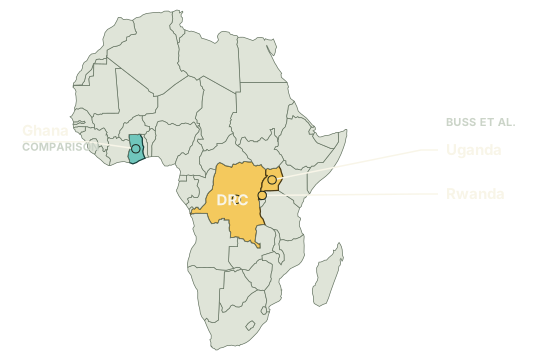
Buss et al.: 878 survey participants, 60 focus groups with more than 400 participants, 28 life histories and repeated observation, 2015 to 2017. National boundaries are Natural Earth 1:110m; colours show country scope, not mine sites.
Prestea · Gender and child labour
Direct Ghana evidence
Prestea and Bondaye, 2017. One 93-person qualitative dataset included 49 women workers, 19 male miners, site committees, local and traditional leaders, an association official and migrant-women focus groups.
Direct Ghana evidence
Observed jobs had regular pay, protective equipment, health arrangements, injury insurance, water, toilets and shelter.
Women included a supervisor, equipment operator, production worker, nurse or health assistant and office or cleaning staff.
Carrying, washing and amalgamation work, often performed by women at labour-intensive sites, had been replaced by machines.
Mechanised firms recruited for experience and competence. Women with less access to technical training could be excluded before job quality is counted.
Gendered value of mining
These are within-gender comparisons reported by the authors, not a women-versus-men pay comparison.
Who is modernisation for, and whose livelihood is treated as expendable?
What Fern should keep track of
Measure before, during and after the policy. Publish outcomes by role and social position, not only participant totals.
Affected communities
Obiri et al. sampled ten water sites over ten months and surveyed 250 residents. Many sampled-site metal levels exceeded drinking-water guidelines; residents also reported water and farmland loss.
The study had no control watershed and could not trace pollution to individual mines or separate all surface-mining sources.
Mining policy is also water, food, health, land and intergenerational policy.
Define success before choosing a measure
Lower damage or exposure per unit.
A smaller total footprint where extraction must fall.
People can stop without losing basic security or power.
Technology or formalisation may improve the first while increasing output. A ban may reduce visible activity locally while failing on livelihoods or displacement.
Ghana policy status · checked 3 October 2026
Parliament still lists the Minerals and Mining Bill, 2026 as a bill. This deck keeps Act 703 as the working legal baseline until an enacted replacement is confirmed.
The Ministry reports operations, arrests and equipment seizures. These are activity counts, not evidence that total harm fell or livelihoods became safer.
NAELP remains listed in Ministry RTI material available in 2026. rCOMSDEP launched its first cooperative scheme in June 2026. Independent outcomes are not yet established.
Act 1140 centralised gold-trade regulation. On 3 September 2026, GoldBod still described the national traceability system as being procured.
A programme architecture is not an outcome.
The Ghana evidence gap
| Reported indicator | What it tells us | What remains unknown |
|---|---|---|
| people trained | delivery and reach | income, job durability, return to mining |
| equipment or plants | inputs deployed | use, maintenance, rebound, who benefits |
| licences or cooperative members | formal enrolment | conduct, worker rights, exclusion, capture |
| gold purchased or exported | formal-channel volume | verified origin and lower mine-level harm |
| sites closed or arrests | enforcement activity | net extraction, livelihood cost, displacement |
No retained independent evaluation measures Ghana's current package across environment, livelihoods, distribution, rights and displacement.
The next section · Five measure families
The sequence moves from restricting harmful activity to changing livelihoods, legal access, technology and markets. Measure 3 is the longest because formalisation changes several kinds of power at once.
After Measure 5, the deck compares lessons from other sectors and assembles the policy package.
Measure 1 · Restrictions
Credible no-go rules can stop activity in a bounded place, especially when enforcement reaches organisers, finance and equipment.
Income disappears while demand and productive capacity remain. Activity may hide, move, become more dangerous or rely on more powerful intermediaries.
Interviews with 58 selected former young miners in Ghana describe income loss, debt, family strain and coping during the ban.
Measure 2 · Livelihood support
Without a clear path that makes mining unnecessary, farming, training or a small business may simply be added while mining continues.
Measure 3 · Formalisation
Visibility, secure tenure, investment, inspection, safer schedules, wages, insurance and environmental capacity.
High cost, delay and unsuitable land favour connected operators. Workers can remain informal under a formal licence, while new machinery expands extraction.
Formal status is an input. Conduct and outcomes are the test.
Regulate each form of power differently
Make the miner route attainable: suitable land, proportionate fees, clear decisions, time limits and shared technical services.
Keep firm limits on location, water, mercury and cyanide, labour, restoration and community rights, regardless of formal status.
Require buyers, aggregators, financiers and equipment owners to verify origin, disclose ownership, reconcile volumes and report anomalies.
Cross-check licences, production, purchases and payments. Publish audits and provide an appeal route independent of sellers, buyers and chiefs.
Brazil's 2013 rule kept transaction paperwork but weakened first-buyer liability for false origin claims. The final peer-reviewed study estimates almost 10 additional homicides per 100,000 people in more-exposed municipalities, about a 30% increase.
Kumah 2022 · What the headline number can and cannot say
The paper repeats an older estimate for Ghana's ASM sector. Its 58 interviews did not calculate this percentage, and the denominator, reference year and present-day precision remain uncertain.
Kumah 2022 · Official guidance checked 3 October 2026
Kumah 2022 · Current legal check: 3 October 2026
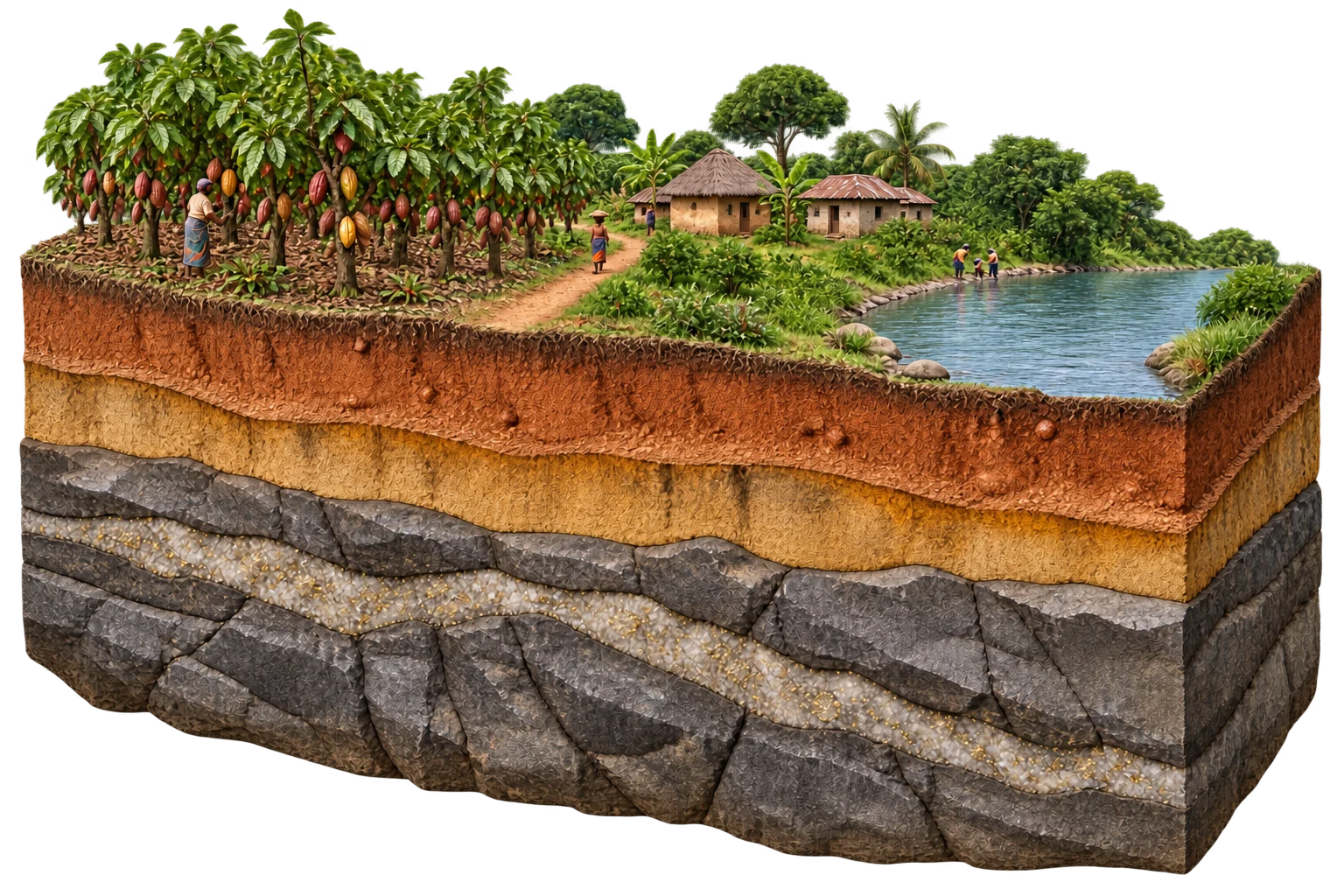 AI-generated explanatory image, not a mapped place
Kumah 2022 · One label, different operations
Alluvial work described as a survival activity along riverbeds.
Deeper and more capitalised extraction can disturb larger areas and waterways.
A trommel is a rotating screen used to wash and separate material by size.
Field visit · A methodological prompt, not a proven recipe
Telephone interviews, full anonymity and local recruitment support appeared to encourage openness about sensitive and potentially illegal activity.
There was no in-person comparison. The study cannot isolate whether the phone, anonymity, trust, recruitment or pandemic context produced greater disclosure.
Recommendations · Keep proposal and evidence separate
Measure 4 · Cleaner technology
Can miners afford and access the equipment?
Is it used correctly and consistently?
Who pays for parts, repair and oversight?
Does recovery increase output or remove women's work?
The evidence includes abandoned equipment, maintenance failures, weak gender results and toxin substitution, alongside some sustained improvements.
Independent evaluation · 2022
Five countries. Three completed mercury-reduction pilots. A post-completion test of whether equipment, institutions and behaviour lasted.
Where and how the pilots were assessed
Burkina Faso and Senegal
Equipment sites in Sud-Ouest and Kédougou. Mali was planned but received no activities because of insecurity.
Ecuador and Peru
Border project around the Puyango-Tumbes watershed, linking mining and downstream contamination.
Philippines
Several pilot areas, including Diwalwal, where later enforcement differed from other sites.
First: what was actually implemented
The evaluation grouped countries into three regional projects, but governments and project teams used different measures.
Second: what worked, what failed and why
What improved: The Ecuador-Peru project reported a 40% reduction after recalculation, and stakeholders later described further decline.
What failed or remained unsafe: Promoted gravity methods were not widely adopted. Cyanidation and flotation drove much of the decline, while poorly managed cyanide tailings remained a pollution problem. Long-term monitoring stopped.
Why: Cyanide was accessible and efficient. The mercury ban criminalised remaining users but did not supply a complete safer system.
What improved: Some assisted miners reported completing formalisation after the project.
What failed: None had completed it by project closure; most miners remained informal nationally. Sediment and biological monitoring did not continue, and promoted gravity methods were not widely adopted.
Why: Formalisation was slow, institutional memory weakened through staff turnover, and cyanidation was easier to access. Peru did not impose a complete mercury ban.
What improved: Equipment initially reduced mercury use for some processing stages. Mercury use remained below its earlier level.
What failed: Some machinery stopped working, so miners returned to mercury for some steps.
Why: Spare parts, local maintenance skills and continued finance were missing. National action plans were completed only later with additional GEF funding.
What improved: The project reported 368 kg less mercury use per year, lower blood and hair levels among participants, and a miners' association that remained active and grew.
What failed: Biomonitoring stopped. Mercury use kept falling in some sites but showed no improvement in others.
Why: Diwalwal was both the only site with further decline and the only one with evidence of stronger enforcement. The evaluation could not isolate enforcement's causal effect.
The uncomfortable findings
A project claim changed materially after the terminal evaluation recalculated it.
Miners praised new equipment mainly for better recovery, not for health protection.
The durable substitute was often a different toxin that the pilots had not promoted.
Without continued biomonitoring, the reported health improvement could not be checked after closure.
A fall in mercury use is not enough evidence that total harm fell.
A mercury project is not yet a just transition
Projects recognised women’s low-paid and highly exposed roles. Most results frameworks still counted participation, with few indicators of power or economic improvement.
People consuming contaminated water or fish were not directly served by GOLD, even though they can bear harm without mining income.
Buyers can be exploitative, but they also provide proximity, supplies and credit. Only one newer project specified livelihood mitigation if buyers were removed.
Most work centred on mercury and project facilities. Water, land, forests, biodiversity and damage beyond selected sites received less attention.
What Fern should carry into Ghana
Measure mercury, cyanide, tailings, water, health, recovery, income and roles before intervention.
Match yield and cash needs. Fund equipment, credit, parts, operators and maintenance together.
Verify that one hazardous input is not replaced by another unmanaged process.
Track women, workers, owners, buyers, migrants, farmers and downstream residents separately.
Assign a funded institution to monitor, repair, enforce and publish results after donor support ends.
The transferable lesson is a set of design conditions, not a technology shopping list.
planetGOLD
The programme connects formalisation, finance, technology, formal markets and shared learning. That is a stronger starting point than an equipment-only pilot.
The just-transition question is whether the package also expands real options, reduces total harm and shares power.
A system design, not one intervention
Ghana entered Phase 2
Coordinate policy and practice within defined places rather than treat each site in isolation.
Expand financial inclusion and build responsible routes to market.
Support uptake of processing methods that avoid mercury.
Build local skills and share lessons within Ghana and the global programme.
Why the design is promising
Do not confuse programme activity with impact
Gaps identified inside the GEF evaluation
Only one-third of the 369-ton mercury target was expected from child projects. The rest relied on later replication and knowledge diffusion that was hard to monitor or attribute.
GOLD did not fund water or sediment monitoring and did not include activities to improve long-term monitoring of health outcomes.
Land, forests and biodiversity received little funding in Phase 1. Safeguards mostly applied to supported facilities, not damage beyond them.
Projects planned gender analysis, representation and sex-disaggregated counts, but few indicators measured empowerment or equality.
Downstream communities exposed through water and fish were not directly served. Indigenous conflicts were often avoided by locating projects elsewhere.
Shorter supply chains could remove local buyers who also provide credit and supplies. Only one project specified alternative-livelihood mitigation.
Formalisation risk · Working law checked 3 October 2026
Ghana studies report concession overlap, attempted enclosure, temporary corporate access agreements followed by eviction when deposits became attractive, and gains concentrating among actors with land, finance and networks. Adranyi et al. found entrepreneurs operating ASGM companies and employing residents as casual workers.
No retained evaluation follows newly formalised Ghanaian miners and estimates how often a company or financier later acquires legal or practical control. A formalisation-driven corporate grab is therefore a serious risk to test, not a demonstrated programme effect.
Formalisation risk · Safeguards before finance
Record land users, customary claims, tenants, licence holders, workers, operating companies, financiers and beneficial owners. A licence holder cannot represent them all.
Require accessible information, independent advice and fair valuation before transfer, lease, partnership or loss of use. Include women, migrants and tenants directly.
Publish proposed transfers and encumbrances, disclose beneficial owners and related parties, review cumulative holdings, and give affected groups a route to object.
Disclose interest, collateral, default, equipment and offtake terms. Offer patient capital and independent legal support so compliance finance does not become control.
Protect wages, safety, bargaining and profit participation. Do not count a one-off payment or rehiring as a successful transition without durable income and voice.
Track ownership, contracts, defaults, transfers, roles, earnings, land access and decision power for several years, broken down by gender, wealth, tenure and migrant status.
Collective organisation · A contested institution
Seven self-organised women's groups supported savings, welfare, work access and resistance to male exclusion. Women also reported favouritism, class divisions and occupational exclusions. Qualitative evidence from one district, not a causal evaluation.
In two mandated cooperatives, leaders came through political, customary and trading networks; miners reported little voice and weak accountability. The study used 43 interviews and six focus groups, but its purposive conflict-setting cases cannot establish prevalence or direct transfer to Ghana.
Across six mine areas, existing male control of land, capital and authority shaped access to associations. Some women still gained referrals, standing or mutual support. This large mixed-method study described mechanisms; it did not evaluate a cooperative reform.
DRC, Rwanda and Uganda
Five men supplied most capital and, respondents said, made all decisions. A woman processor reported that members were contacted for money, but not useful information.
Mechanism: formal organisation consolidated founder, investor and landowner power.
A women's committee dealt with literacy and sensitisation but was described as peripheral to mining decisions. In a cooperative headed by the chief's wife, members reported centralised decisions and “no redistribution of wealth.”
Mechanism: descriptive representation without member control.
Former members recalled loans, health insurance, advocacy and a private space to discuss family planning. They wanted it restored. The study does not establish why it ended or that the state closed it.
Mechanism: autonomous space and material support, with uncertain durability.
Grassroots organising · state-led inclusion · state administration
Women organised around work access, savings, welfare and resistance to eviction. Their groups created bargaining power but still contained favouritism, class divisions and occupational exclusions.
Question: how can support strengthen capacity without taking over the agenda?
The official programme promotes locally owned cooperatives, legal concessions, training and shared processing. Official descriptions do not yet establish who selects members, controls facilities or receives value.
Feminist question: does recognition resource women's own agenda, or replace it with a state-designed form?
Roger Owen describes post-1952 compulsory and later nationwide agricultural cooperatives coordinating crops, inputs and marketing. His wider account treats supervised cooperatives as one route through which postcolonial states extended rural administration.
Question: is the collective accountable downward to members, upward to the state, or both?
Formalisation risk · Formalise whom?
The actor with land access, capital, networks and administrative capacity is best placed to obtain the permit and new support.
Diggers, haulers, processors and service workers may remain casual, paid by piece or share, unregistered and unable to influence the formal entity.
Seven months of fieldwork and more than 200 open interviews linked outside capital to greater differentiation. Permits often recognised financiers and landowners while workers remained informal. Strong process evidence, no population estimate or intervention counterfactual.
Eight months, 89 recorded interviews and site observation mapped semi-formal production around tributors, sponsors and layered labour. It shows why a licence-holder count can miss who works and captures value. Two purposive sites, so the pattern is analytically rather than statistically generalisable.
Do not ask only whether an operation or cooperative is legal. Ask which people obtained rights, who remains a worker, whose work is recognised, and whether wages, safety, bargaining power and profit shares changed.
Design implication · Representation is not automatic
A cooperative membership count is not an inclusion result. The test is whether different groups can enter, influence decisions, control assets and share value.
What wider evidence adds
Recommendation for Fern
Formalisation + finance + technology + markets + shared learning is more credible than any one measure alone.
Finance and formal status are means. The tests are harm, livelihoods, power, durability and spillover.
Fern does not need to deliver every function. It can press for the network, guardrails and public evidence that make the package accountable.
Measure 5 · Ghana status checked 3 October 2026
May buy from a miner and sell to a Tier 2 buyer. Published terms require seller identity, receipts, monthly reporting, due diligence and suspicious-transaction reporting.
May buy from miners or Tier 1 buyers and sell to an aggregator. The same public record, ownership and anti-money-laundering duties apply.
May buy from miners and lower tiers for supply to GoldBod. Entry requires much greater capital and fees, making concentration an outcome to measure.
On 16 February 2026 GoldBod suspended new Tier 1, Tier 2 and self-financing aggregator applications; only new aggregator applications remained open. Existing applications continued. This can strengthen coordination and restrict market entry at the same time.
Violence and the first buyer
After first buyers could presume origin declarations were true, the final study estimates almost 10 additional homicides per 100,000 in more-exposed municipalities, about 30% above the pre-change mean.
Qualitative research documents armed robbery, extortion, self-defence groups, site conflict and violent police or military raids around transient mining economies.
GoldBod attributes a substantial share of smuggling to buyers and says concession-level traceability was incomplete. This is an institutional account, not an independent causal study.
For Ghana, monitor violent deaths and injuries, robbery, extortion, firearms, threats to women, migrants and whistleblowers, enforcement violence, suspicious transactions and production-to-purchase mismatches.
New evidence block · Cross-sector studies
The purpose is not to import ready-made solutions. It is to identify recurring mechanisms that can be tested against Ghana's land, labour, market and political conditions.
Learning from other sectors
Replacement fails when a crop also provides credit, land access, cash timing and risk management.
Payments cut short-run tree loss, but enrolment was limited and clearing resumed after payment.
Income protection plus livelihood support can improve average welfare, without proving exit from harmful activity.
Training takes time and assumes jobs exist. It cannot replace income lost tomorrow.
Rights, diverse user participation and adaptation are associated with better outcomes; much evidence is observational.
Packages for formal workers can miss informal work, women, care and place-based loss.
Study 1 of 2 · Yeung et al. realist review
These are documentation gaps, not proof that nothing changed. Many interventions were ongoing, and reporting quality varied.
Study 1 findings · Recurring enablers and barriers
Study 1 cases · Recognition and power
Mechanism: a technical solution that did not match residents' aspirations or recognise their knowledge lost legitimacy. Participation after key choices could not repair the original mismatch.
Peer-reviewed qualitative case studyStudy 1 cases · Local institutions and livelihoods
Comparison · After both studies
Yeung et al. reconstruct how interventions were intended or reported to work, for whom and in what context.
FindsEngagement, trust, local fit and collaboration recur as mechanisms associated with climate and social outcomes.Cannot establishAn average causal effect of participation.Gather et al. retain 80 interventions and test combinations linked to a composite output proxy.
FindsDocumented engagement is absent or low in most labelled solution terms, alongside funding and planning.Cannot establishThat removing participation improves results.Study 2 of 2 · Gather, Prowse and Seussler 2025
Before the findings · The shared evidence base
These counts cover 98 interventions. One continent-scale Africa intervention was omitted from the review's regional figures. The English-only search produced little small-island evidence.
*Cross-sector is the derived remainder after the four published single-sector counts. These are review-wide counts; the paper does not publish this breakdown for the 80-case QCA subset.
Study 2 results · Published complex-solution metrics
Study 2 diagnostics · The appendix and regression
The vertical marker is the study's stated 0.90 threshold for calling a condition necessary.
Fractional-logit coefficient with standard error below. Green is positive; clay is negative. Only funding is statistically significant in this composite model.
Study 2 findings · Seven reported configurations
Study 2 interpretation · A justice safeguard
The paper also reports policy alignment absent in more than half. It suggests central coordination or institutional flexibility may sometimes support short-run outputs. Table 3 conflicts with Table 1 for configuration D.
A stronger comparison than participatory versus state-led
Historical lenses, not transferable models
Blind spot: rapid institution-building was elitist. Many former samurai lost income, tenant farmers bore costs, and the later imperial trajectory makes this a poor justice template.
Blind spot: neither book provides a matched Japan-Egypt evaluation. Owen documents institutional functions and tensions; Acemoglu and Robinson offer a broad historical theory.
Study 2 limits · Blind spots and transfer boundaries
New section · From evidence to policy design
The next slides stop reviewing interventions one by one. They combine the findings into policy functions, sequencing rules and safeguards for a just transition in Ghana.
The package logic
Creation without constraint can add another activity. Constraint without protection can destroy options.
General levers, locally designed
Places, thresholds and deadlines.
Income, food, health and debt protection.
Land, finance, buyers, care and viable work.
Suitable land, proportionate rules and shared services.
Rights, organisation, prices and joint decisions.
Obligations for organisers, equipment, finance and buyers.
Restoration, health, compensation and appeal.
Detect relocation, diversion and origin laundering.
Multi-year finance, evaluation and correction.
Sequence matters
Do not ask people to cross a bridge before it exists.
What can go wrong
| Measure alone | What it misses | Possible harm |
|---|---|---|
| enforcement | income functions and demand | debt, concealment, selective policing, relocation |
| licensing | land, capital and worker status | rights and profit concentrate in connected operators |
| training | jobs, cash timing, care and buyers | attendance without a viable livelihood |
| cash | productive assets and markets | temporary relief followed by return |
| clean technology | scale, ownership and rebound | more extraction or displaced women's work |
| traceability | mine practice and excluded miners | clean paperwork, dirty production or diversion |
| buyer exit | corrective finance and other routes | risk moves to weaker producers and buyers |
Do not mistake movement for reduction
Workers, equipment and extraction move.
Gold takes another route while mining stays.
Documents or intermediaries conceal the mine.
Water, sediment or exposure crosses boundaries.
ECOWAS cooperation should link customs and finance with labour rights, migrant protection, watershed monitoring and livelihood support.
New section · From policy design to delivery
A policy package is also a distribution of authority, money, duties and risk. This section maps who must participate, who must be regulated and who must be able to challenge decisions.
Actor map 1 of 5 · Rights-holders
Actor map 2 of 5 · Current law checked 3 October 2026
Chiefs, tendanas, family heads, queen mothers and councils can map interests, convene negotiations and contribute dispute knowledge. They must disclose conflicts, payments and beneficiaries.
Women, tenants, migrants, farmers, workers, downstream users and other customary users need separately selected seats. A chief cannot substitute for them or consent on everyone's behalf.
Public agencies set mineral, environmental and labour rules. Independent review must publish reasons and payments, audit compliance and hear appeals outside the licensing and purchasing chain.
Actor map 3 of 5 · Ghanaian duty-bearers
Actor map 4 of 5 · Ghanaian power and scrutiny
Actor map 5 of 5 · Beyond Ghana
Representation
Workers by role; women inside and outside mining; tenants and landowners; migrants; former miners; downstream and forest-edge residents; fishers and other resource users.
Chiefs, licence holders, cooperative leaders, household heads, professional women's groups, district officials, buyers and NGOs. A cooperative leader does not represent every member or worker.
A chief is not every customary user. A licence holder is not a worker. A miner is not a downstream resident.
No one organisation can deliver the system
Define acceptable outcomes, select representatives, monitor harm and use independent remedy.
Align land, mining, water, farming, labour, health, purchasing and social protection.
Buyers, refiners, financiers and equipment owners fund verified improvement and repair.
Ghana-led research, laboratories, audits and public reporting track distribution and displacement.
Fern does not need to do everything. It can help make the whole system accountable.
Recommendations to Fern
Affected communities and Ghanaian researchers define outcomes and evidence.
No criminalisation-first package and no success claim based only on arrests or exports.
Income protection and tested options before restrictions, except immediate danger.
Buyers and finance support correction, verification and remedy without automatic exit.
Community monitoring, water science, worker evidence, open contracts and safe complaints.
Monitor districts, borders and trade routes with ECOWAS partners.
Before advocacy or scale-up
Who is missing because they lack title, licence, time, membership or safety?
Does support match net income, timing, debt, risk and duration?
Who can join, vote and hold office? Who controls land, licences, finance, contracts, price, equipment and complaints after formalisation?
Will total harm fall after rebound and toxin substitution?
Where could people, extraction, finance, gold or pollution move?
What evidence triggers expansion, redesign, compensation or stopping?
Next-stage research
Track owners, workers, tenants, women, migrants and affected non-miners before, during and after intervention. Include destination districts and watersheds.
Absolute harm; livelihood security; social reproduction and future wellbeing; distribution; power; displacement and durability; implementation and cost.
Use counterfactual evaluation where possible, realist synthesis for mechanisms, and meta-analysis only for genuinely comparable interventions.
Use Ghana-led protocols, open methods, independent laboratories, conflict disclosure, community data governance and publication of harmful or null results.
Bottom line
Protect people. Create viable options. Constrain the harmful system. Repair damage. Test every package for unequal effects and displacement.
Fern's strategic role is to help build the relationships, rules, finance and accountability that stop any one measure from becoming another source of harm.
recommendation from the full synthesisClickable bibliography 1 of 5
Adranyi, Stringer and Altink (2023). The impacts of artisanal and small-scale gold mining on rural livelihood trajectories. Mixed-method study in Atiwa West.
Adranyi et al. (2024). Joined-up governance for livelihood vulnerability and mining impacts. Same underlying Ghana field project as the 2023 paper.
Arthur et al. (2016). Mixed-method livelihood study in Prestea, Bondaye and Himan, including reported participation by women and children.
Yakovleva et al. (2022). Gender equality, women’s authority and the likely effects of bans and formalisation in Prestea and Bondaye.
Arthur-Holmes and Busia (2021). Women’s work, care, safety, wage rights and inter-ethnic discrimination in Prestea and Bondaye.
Ofosu, Torbor and Sarpong (2022). Women’s employment and occupational conditions in two formalised, mechanised Ghanaian ASM firms.
Baddianaah, Tuu and Baatuuwie (2021). Livelihood implications of artisanal gold mining in farming communities, Wa East.
Obiri et al. (2016). Environmental and socio-economic impacts in Tarkwa Nsuaem, including repeated water sampling.
Osei et al. (2021). Ghana's ASM ban, youth livelihoods and imagined futures. University of Ghana and KNUST.
Hilson and Banchirigah (2009). Are alternative livelihood projects alleviating poverty in mining communities?
Clickable bibliography 2 of 5
Adu-Baffour, Daum and Birner (2021). Governance challenges of small-scale gold mining in Ghana: a Process Net-Map study.
Crawford and Botchwey (2017). Conflict, collusion and corruption in small-scale gold mining in Ghana.
Kumah (2022). Formalisation barriers and customary legitimacy in Ghanaian small-scale mining.
Mensah (2021). Legal pluralism, customary tenure and large-scale mining bias in Ghanaian ASM formalisation.
Parliament of Ghana (2020). Land Act, 2020 (Act 1036), including fiduciary duties and Customary Land Secretariats.
Constitution of Ghana, arts 257 and 267. Distinguishes minerals vested in the Republic from stool land held in trust for stool subjects.
Office of the Administrator of Stool Lands (2026). Current implementation account for Land Act 2020 and expansion of Customary Land Secretariats.
Arthur-Holmes and Mengba (2024). Informal women's mining cooperatives in Talensi, Northern Ghana.
McQuilken and Hilson (2018). Production networks and layered labour in Ghana's alluvial diamond sector. Open thesis with full methods.
Parliament of Ghana (2006). Minerals and Mining Act, Act 703, including mineral ownership and transfer rules.
Parliament of Ghana (2026). Current Bills catalogue, listing the Minerals and Mining Bill, 2026 as laid and gazetted on 26 May 2026.
Minerals Commission (checked 3 October 2026). Published eight-stage small-scale-mining licence guidance; its three-year renewal statement conflicts with Act 703 section 85 and the Commission's mineral-rights table.
Environmental Protection Authority (2026). Current permitting notice under Act 1124 and L.I. 2504, including small-scale mining.
Ministry of Lands and Natural Resources. National Alternative Employment and Livelihood Programme.
Ministry of Lands and Natural Resources (2026). First rCOMSDEP cooperative scheme launch at Akyem Kotoku.
Parliament of Ghana (2025). Ghana Gold Board Act, 2025 (Act 1140).
Ghana Gold Board (3 September 2026). Latest located official status still describes the national traceability and assurance system as under procurement.
Clickable bibliography 3 of 5
Tsang et al. (2019). Systematic review of occupational-health interventions in artisanal and small-scale gold mining.
GEF Independent Evaluation Office (2022). Evaluation of GEF interventions addressing artisanal and small-scale gold mining.
planetGOLD (2025). Global Project Assessment, Phase 1. Programme-authored account of global tools, coordination and lessons.
planetGOLD Ghana (2023). Inception workshop, project components, finance and stated targets.
planetGOLD Phase 2. Programme scope and integrated formalisation approach.
Álvarez-Berríos et al. (2021). Formalisation, land cover and mining expansion in Peru.
IMPACT (2021). Just Gold lessons from incentive and traceability work.
BGR (2019). Traceability in artisanal gold in Kampene, DRC.
De Haan and Geenen (2016). Mandated mining cooperatives, elite capture and revenue distribution in eastern DRC.
Verbrugge (2015). Formal recognition of ASM entrepreneurs alongside persistent informal labour in the southern Philippines.
Buss et al. (2019). Social reproduction, gendered livelihoods, authority and likely formalisation effects in DRC, Rwanda and Uganda.
Pereira and Pucci (2024 working paper; 2026 article). A Tale of Gold and Blood, Brazil.
Brugger et al. (2024). The state and the legalisation of illicit financial flows: trading gold in Bolivia.
Stoop et al. (2018). Mining ban, mineral substitution and conflict in eastern DRC.
OECD (2018). Gold at the crossroads: assessment of supply chains in the Liptako-Gourma region.
Clickable bibliography 4 of 5
DFID (1999). Sustainable Livelihoods Guidance Sheets, including the five-capitals asset framework.
Scoones (1998). Sustainable Rural Livelihoods: A Framework for Analysis. IDS Working Paper 72.
Roe et al. (2015). Systematic review of alternative livelihood projects and conservation.
Mansfield (2020). Alternative development and opium-poppy livelihoods in Afghanistan.
Jayachandran et al. (2017). Cash for carbon and forest conservation in Uganda.
Leight et al. (2024). Cash-plus programming and economic outcomes.
Walk et al. (2021). Gender and justice in coal transitions.
Kivimaa and Kern (2016). Policy mixes for sustainability transitions.
Gather, Prowse and Seussler (2025), full text. Pathways towards just transitions in the Global South. Publisher record.
Yeung et al. (2026). Peer-reviewed realist review of just-transition interventions in developing countries. Read the complete 2024 IEU and ILO report.
Mejía, Restrepo and Rozo. Quasi-experimental evidence on enforcement and illegal coca markets in Colombia.
Toledo Orozco (2022). Gold-mining displacement and environmental governance.
Clickable bibliography 5 of 5
Acemoglu and Robinson (2012). Why Nations Fail. Used for its distinction between inclusive and extractive institutions and its historical interpretation of Egypt and Meiji Japan, not as an intervention evaluation.
Acemoglu and Robinson (2019), full accepted manuscript. Rents and Economic Development: The Perspective of Why Nations Fail. Defines inclusive political institutions as a capable state combined with broadly distributed power.
Yamada (2022), open article. Making Reform and Stability Compatible with Each Other: Elite Redeployment in Meiji Japan. Challenges the participatory reading of Meiji institutional change and documents its authoritarian, elitist mechanisms and uneven effects.
Owen (2004). State, Power and Politics in the Making of the Modern Middle East, used as a historical lens on rural state expansion.
Owen (1999), full paper. A Long Look at Nearly Two Centuries of Long Staple Cotton. Documents the productive, administrative and distributive functions of Egypt's supervised cooperative system.